
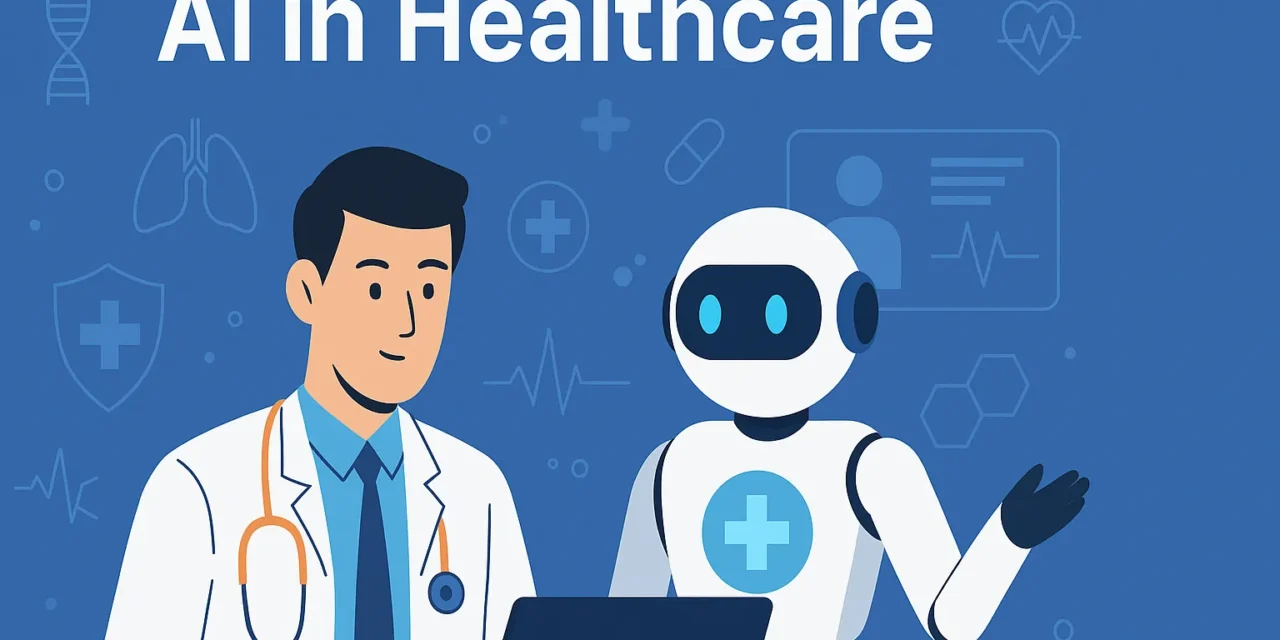
Healthcare Meets Artificial Intelligence
Artificial Intelligence (AI) is no longer a futuristic concept—it’s already shaping how we diagnose diseases, deliver treatments, and manage clinical operations. From helping radiologists spot early cancer to enabling real-time chat-based triage, AI in healthcare is not only augmenting the work of doctors but, in some cases, replacing traditional systems altogether.
One of the most groundbreaking innovations to date is Agent Hospital, China’s first entirely AI-powered virtual hospital developed by the Institute for AI Industry Research (AIR) at Tsinghua University. But beyond this single system lies a broader transformation—an AI-driven shift in how we deliver care across the globe.
What Is Agent Hospital? A Glimpse into AI-Native Medicine
Agent Hospital is a virtual medical system that simulates a fully functioning hospital staffed entirely by AI agents. It features:
42 AI doctors across 21 medical specialities
Powered by MedAgent-Zero, an advanced clinical reasoning engine
Achieved a 93.06% accuracy rate on the MedQA benchmark
Capable of managing 10,000 patient cases in a day
 This isn’t just chatbot-level AI. It’s a scalable, intelligent system that can simulate consultations, diagnose conditions, prescribe treatments, and train itself by interacting with virtual patients, eliminating risk to real people during development.
Key Advantages:
Ideal for rural or underserved areas with few doctors
Enables safe experimentation with complex or rare medical cases
Potential to support medical education and AI model training worldwide
Original source: Rysysth Technologies
Comparing AI-Based Systems vs Traditional Healthcare
1. Diagnostic Speed & Accuracy
AI: Reads radiology scans and pathology slides with expert-level precision. For example, AI in stroke triage has cut treatment times by over an hour in the UK (NHS AI Lab, 2023).
Traditional: Subject to human fatigue, bias, and variability.
2. Operational Efficiency
AI: Automates triage, scheduling, documentation, and decision support.
Traditional: Labour-intensive, with longer wait times and administrative bottlenecks.
3. Personalised & Preventative Care
AI: Uses genomic data and electronic health records to predict conditions early (e.g. AstraZeneca’s UK Biobank).
Traditional: Relies on standardised protocols with limited personalisation.
4. Access & Equity
AI: Low-cost, scalable care via apps and telehealth platforms, ideal for underserved regions.
Traditional: Access is restricted by location, staff shortages, and funding.
Long-Term Advantages of AI in Healthcare
A. Better Patient Outcomes
AI enables earlier diagnosis, improving survival and recovery rates for conditions like cancer, stroke, and sepsis.
B. Lower Costs & Greater Efficiency
According to the World Economic Forum, AI can cut up to $300 billion annually in global healthcare waste through automation.
C. Clinician Burnout Relief
By handling repetitive tasks, AI allows paramedics, nurses, and doctors to focus on patient care, addressing one of healthcare’s biggest issues.
D. Real-Time Monitoring & Early Intervention
Wearable tech and smart sensors powered by AI provide alerts before deterioration occurs—saving lives.
E. Accelerated Drug Development
AI speeds up molecule screening, trial recruitment, and post-market surveillance, reducing time-to-market for new treatments.
Long-Term Disadvantages and Ethical Concerns
A. Bias and Inequity
AI tools can inherit biases from data. A 2019 Science study found that an algorithm under-prioritised Black patients due to skewed healthcare spending metrics (Obermeyer et al., 2019).
B. Lack of Explainability
“Black box” systems limit transparency and make it difficult to justify or explain clinical decisions, raising consent and accountability concerns.
C. Legal Grey Areas
When an AI system makes a mistake, it’s unclear who’s liable: the developer, the NHS trust, or the clinician using the tool?
D. Cybersecurity Risks
AI-connected systems broaden the attack surface for ransomware and data theft, particularly in the overstretched NHS digital infrastructure.
E. Environmental Impact
Training AI models is energy-intensive. A single large model can consume more energy than five cars do over their lifetimes (Strubell et al., 2020).
AI in UK Ambulance Services: Case Studies and the Future of Prehospital Care
Case Study 1: AI-Powered Dispatch Triage – NHS 111 and 999
NHS 111 and 999 call triage now incorporates AI algorithms that assess urgency, symptoms, and escalation needs. Trials have shown faster Category 2 response times and better ambulance resource allocation.
Case Study 2: NLP for epcr Documentation
Services such as the East of England Ambulance Service are trialling Natural Language Processing (NLP) to improve electronic Patient Care Record (ePCR) workflows—saving up to 30% of documentation time.
Case Study 3: Predictive Models for Mental Health Calls
AI is used to analyse call data and identify frequent callers, enabling pre-emptive mental health interventions and community referrals, reducing strain on frontline resources.
How AI Could Shape Prehospital Care in the Next Decade
Looking ahead, AI will likely touch every part of the ambulance journey:
Onboard Clinical Decision Support: Real-time ECG interpretation, trauma triage, and drug dosage calculators.
AI-Assisted Triage Apps: Used by the public to filter low-priority calls before they even hit 999 dispatch.
Teleconsultation En Route: Paramedics could access AI-augmented specialist portals to make critical decisions faster.
Training and Simulation: AI-generated cases for rare emergencies (e.g. paediatric cardiac arrests) will aid skill retention and confidence.
Risk Prediction Models: AI could help flag patients safe for non-conveyance or at high risk of deterioration.
AI won’t replace paramedics—but it can significantly enhance their decision-making, safety, and efficiency under pressure.
The Future: Hybrid, Human-Centred Systems
The future of healthcare is hybrid. AI will not replace clinical judgment—it will augment it. Success will depend on:
Governance: Strong regulation, bias checks, and real-world testing.
Training: Upskilling clinicians in AI literacy and digital ethics.
Transparency: Ensuring patients and clinicians understand how AI decisions are made.
Green Tech: Addressing the environmental costs of large-scale AI.
Conclusion: AI as a Prehospital Ally, Not a Replacement
AI represents the most transformative innovation in healthcare in a generation. In hospitals, ambulances, and community care, it has the potential to improve access, accuracy, and efficiency—but only if deployed ethically, transparently, and in partnership with the professionals who deliver care.
Used wisely, AI could democratise healthcare. Used blindly, it could deepen inequality and erode trust.
The question isn’t whether AI belongs in healthcare, but whether we’re ready to use it responsibly.