



Introduction
So, you’ve decided to become a paramedic: cue applause, mild panic, and a rabbit hole of university websites. Choosing the right university to train isn’t just about picking a place that serves decent coffee (though, let’s be honest, that helps). It’s about setting yourself up for a career where your skills, confidence, and resilience will be tested daily.
Here’s a no-nonsense, slightly cheeky guide to help you pick a uni that’s more “life-changing experience” and less “what have I done?” We’ve also added a practical section on funding, entry requirements, deadlines and more.
Let’s get this out of the way: if the course isn’t approved by the Health and Care Professions Council (HCPC), it’s a hard pass. This isn’t just red tape, it’s your ticket to actually working as a paramedic in the UK. Without HCPC accreditation, you’ll have a lovely degree and precisely zero ability to register or get a job.
Always check the HCPC’s official register before you even consider applying.
Placements are where you’ll discover if you’re cut out for life in the fast lane (or at least the blue-light lane). Not all placements are created equal. Ask these questions:
- Which ambulance service trust does the university partner with? Some trusts are busier, while others are more rural, and each has its unique quirks.
- How much time is spent on placement vs. in-class? You want a healthy balance. Too much classroom, and you’ll be itching for action; too much placement, and you might miss out on theory.
- Are placements block-based (big chunks) or spread out? Block placements can immerse you, but spread placements keep your skills ticking over all year.
- Will you get a variety of experiences? The best courses offer time in A&E, mental health, GP settings, and even specialist teams.
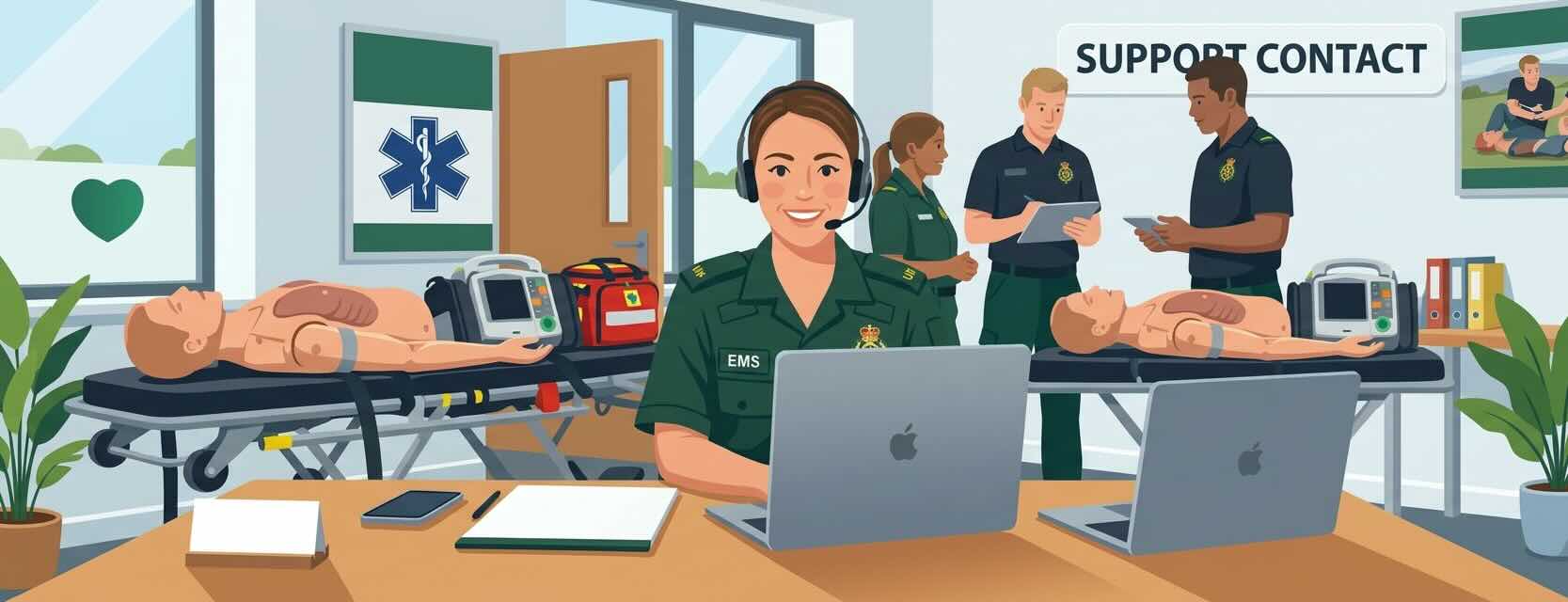
Let’s be honest: nobody wants to be the one who fumbles the oxygen mask on their first day. Good simulation facilities are your friend. Look for:
- Ambulance simulators (bonus points if they have working sirens)
- Mock A&E or home environments for realistic scenarios
- High-fidelity manikins (the ones that sweat, bleed, or at least don’t look like crash test dummies)
- On-site skills labs for hands-on practice
The more realistic the training, the less terrifying your first real shift will be.
You want lecturers who’ve seen it all, from minor scrapes to major incidents. Ideally, your course will be taught by current or former paramedics with experience in advanced roles like critical care, HEMS (Helicopter Emergency Medical Services), or tactical response. Their stories (and scars) will teach you more than any textbook.
It’s not just about getting through the course; it’s about what happens next. Look for:
- What percentage of students are employed or in further study six months after graduating? The higher, the better.
- Do graduates move straight into ambulance services, or do they take scenic routes?
- Are there links to specialist paramedic pathways or postgraduate study for those who want to keep climbing?
Some courses are heavy on the theory, others are all about practical skills. The dream? A bit of both. Check if the course offers:
- Research modules (for the budding scientist in you)
- Interprofessional learning (working with nurses, doctors, and other healthcare students)
- Elective placements abroad (sun, sea, and sirens?)
Pick a structure that matches your learning style. If you love hands-on, steer clear of essay-heavy programmes.
Never underestimate the impact of location. Consider:
- How far are placements from the uni? (Commuting at 5 a.m. is a vibe. A bad vibe.)
- Do you want to stay close to home or explore somewhere new?
- What’s the cost of living in the area? (London: bring your sandwiches. Everywhere else: maybe you can afford avocado toast.)
Uni is about more than lectures. It’s your life for the next few years.
Some unis have legendary status in the paramedic world. Ask around on Reddit, Facebook paramedic groups, EMS forums, and LinkedIn. You’ll get the unfiltered truth (and probably some horror stories).
Entry requirements, funding and deadlines change and vary between universities, so treat this as a starting point and always confirm details on the university’s own course page and the official sites linked below.
Requirements differ a lot between universities, but you’ll commonly see a mix of the following:
- A-levels or equivalent: one ambulance trust’s partner universities ask for grades from around BBB to AAB, with a science subject often preferred.
- BTEC or T-Level: a health-related BTEC (around DDD to DDM) or a health or science T-Level is often accepted.
- UCAS tariff points: some universities quote a range instead, for example 112 to 136 points.
- Access to HE diploma: usually in a health or science subject, often with a set number of Distinction and Merit credits.
- GCSEs: typically English, maths and science at grade C/4 or above.
- College route: an HNC or HND in a health or science subject can lead into a degree, and many universities run access programmes.
The degree itself takes 3 years at undergraduate level, or 2 years if you already hold a degree and take a postgraduate route.
Most UK students can apply for a tuition fee loan and a maintenance loan through Student Finance. On top of that, eligible paramedic students can apply for the NHS Learning Support Fund, which isn’t means-tested and doesn’t have to be repaid:
- Training grant: £5,000 per academic year.
- Parental support: £2,000 per year to help with childcare costs.
- Travel and dual accommodation: help with extra costs of getting to placements.
- Exceptional support fund: up to £3,000 per year in cases of financial hardship.
You apply through the NHS Business Services Authority, not Student Finance. If you already have a degree, you may still be able to access the Learning Support Fund, subject to meeting the other eligibility criteria.
Not everyone goes straight from college to a lecture theatre. The paramedic degree apprenticeship is a level 6 route where you’re employed by a healthcare provider while you study.
- It typically lasts around 3 years, with the option to shorten it through recognised prior learning.
- You apply for an apprentice position with an employer rather than through UCAS. Vacancies appear on NHS Jobs and Find an Apprenticeship.
- Some trusts open their programmes to existing ambulance staff in patient-facing roles.
- Competition is high, and employers often expect relevant experience and a full manual driving licence.
Requirements differ between trusts and universities, so check each vacancy carefully.
It depends on the university, but the pattern is fairly consistent:
- Some universities don’t require a licence to apply, because driving isn’t part of the regulated standards for paramedic practice.
- Many still strongly advise having a full licence before you start, and getting the C1 category (vehicles up to 7.5 tonnes) before you finish.
- Ambulance trusts usually expect a full manual licence when you apply for jobs, and C1 is often needed. Some trusts say C1 is desirable but not essential at application stage.
If your licence was issued before January 1997, it may already include C1. Otherwise you’ll need to apply to the DVLA. If you can’t drive for health reasons, talk to the course team early.
For courses starting in 2027, the key UCAS dates look like this:
- 13 January 2027 (18:00 UK time): equal consideration deadline for most undergraduate courses, including paramedic science.
- After the deadline: universities may still accept late applications if places remain, until the end of June.
- Interviews and offers: many universities interview applicants and aim to send decisions by around the end of March if you applied by the January deadline.
- 2 July 2027: Clearing opens.
The 15 October deadline you may have seen applies to medicine, dentistry, veterinary courses and Oxford and Cambridge, not paramedic science. Interview coming up? Have a look at our paramedic science interview questions guide.
An offer is usually conditional on a few checks being completed before you start:
- Enhanced DBS check: a criminal records check. Certificates can take up to around 60 days, so start as soon as you’re asked to.
- Occupational health clearance: a health questionnaire and review, to make sure you’re fit for placement.
- Immunisations: typically evidence of hepatitis B, MMR and TB protection, depending on the university’s policy.
- Blood-borne virus testing: some universities test new students for HIV, hepatitis B and hepatitis C, because of exposure-prone procedures.
- References: usually two satisfactory references.
Failing to meet the placement vaccination policy can stop you joining the course, so don’t leave this to the last minute.
- Shifts: placements typically follow the full 24-hour pattern, including long 12 to 13 hour shifts, nights, weekends and bank holidays.
- Time on placement: around half of the course is spent in practice settings at some universities, and placement weeks can be full-time.
- Attendance: some universities require 100% attendance across the programme.
- Travel: placements can be spread across a wide area, so be prepared to travel or stay away from your term-time address. The Learning Support Fund can help with extra travel and accommodation costs.
- Part-time work: possible at some universities, but it has to fit around your teaching and placement shifts.
Direct ambulance experience is rare and not usually expected, but care experience is valued, and some universities require some. That can include:
- Volunteering with St John Ambulance, the Red Cross or as a community first responder
- Care work, hospital or care home volunteering, or healthcare support roles
- Cadets, caring for a family member, or any pressured public-facing job
Postgraduate routes can ask for more. One MSc course, for example, asks for 150 hours of direct care experience. Whatever you’ve done, show in your personal statement what you learned from it.
FAQs
Visit your shortlisted unis if you can. Poke around the skills labs, chat to staff, and grill current students for the good, the bad, and the ugly. Trust your gut. And remember: the best simulation manikin is still less dramatic than a real Friday night in A&E.
Still stuck? Drop us a message. You’ve got this, now go find your perfect fit!
Quick Overview
- 1 minute read
- Intermediate level
- Updated 20 Oct 2026