





Virtual Wards
The NHS is accelerating the shift of care from hospitals into the community through paramedic-led treatment, urgent community response (UCR) teams and technology-enabled virtual wards. This forms a central part of the government’s Plan for Change and the 2025/26 urgent and emergency care plan, which prioritises treating more people at home or in familiar surroundings.
Nearly £450 million is backing the wider urgent and emergency care package. Key elements include expanding paramedic-led care so crews can treat more patients at the scene or in their own homes, increasing the number of people seen by UCR teams, and making better use of virtual wards. Local systems must set out how they will grow access to these services.
UCR teams aim to reach people within two hours when their health or mobility suddenly declines and they risk hospital admission. These multidisciplinary teams often include nurses, therapists, advanced practitioners and paramedics. They assess, treat and support patients at home, reducing ambulance conveyances and A&E pressure. Services across England now routinely take referrals from ambulance control, GPs, care homes and, in some places, self-referral or NHS 111. Many operate at least 8am to 8pm, seven days a week, with some extending further.
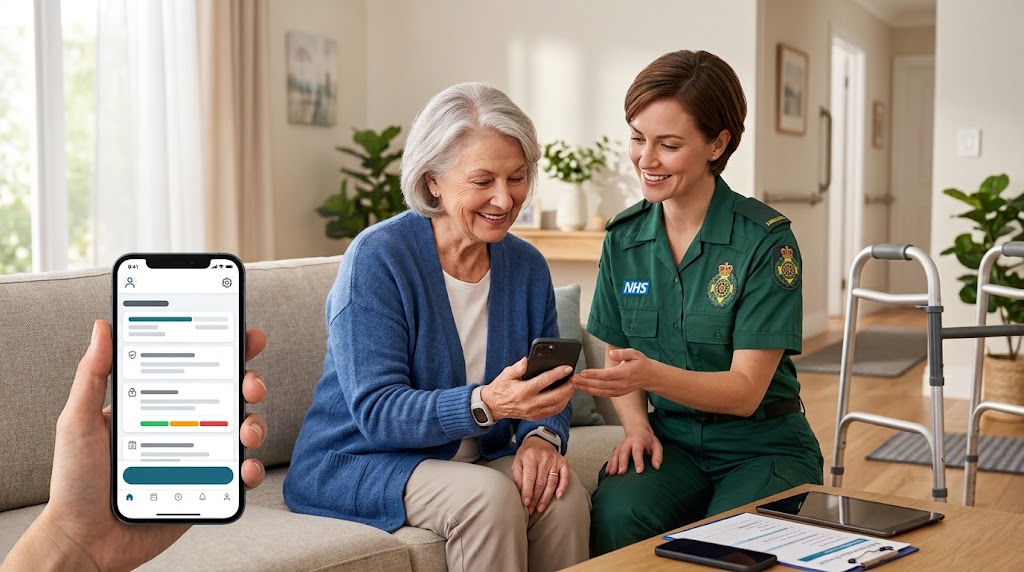
Virtual wards (also called hospital at home) deliver acute-level care in the patient’s usual place of residence. Technology plays a growing role: patients use apps, wearables or simple devices to send vital signs such as blood pressure, oxygen saturation and temperature. Clinical teams monitor the data remotely, carry out virtual ward rounds and visit in person when needed. Capacity across England has hovered around 12,500 beds (roughly 20 per 100,000 population), with many services targeting occupancy above 80 percent. Local examples show continued expansion, including 24-hour coverage and higher-acuity pathways.
Paramedics sit at the centre of both models. They already deliver more “see and treat” care in the community and work alongside UCR and virtual ward teams. In some areas joint response cars pair ambulance paramedics with community clinicians. Virtual ward teams themselves increasingly include senior paramedics as part of the multidisciplinary group. This builds on the profession’s growing role in advanced practice and admission avoidance. For related practical guidance on supporting older adults at home, see the EMSUK Learning guide on helping elderly people stay safe in winter and the elderly faller transport decision aid.
The approach is not unique to the UK. Hospital-at-home and virtual ward models have long been established in parts of Australia (Hospital in the Home), and similar programmes operate in Canada, Spain and elsewhere. In the United States, the Acute Hospital Care at Home waiver has enabled hundreds of hospitals to offer inpatient-level care at home, often involving community paramedics for in-person visits and assessments. The UK’s national scaling through NHS England guidance and funding places it among the more systematically expanded systems.
Patients report high satisfaction with remaining at home. Clinicians note reduced hospital bed days, fewer avoidable admissions and better continuity for people living with frailty, respiratory problems, heart failure and other acute conditions. Challenges remain around workforce capacity, digital access for some patients, consistent out-of-hours cover and ensuring equitable reach. Ongoing national data collection and operational frameworks aim to reduce variation and sustain quality.
For UK prehospital clinicians the direction is clear: more opportunities to treat closer to home, stronger links with community teams, and greater use of technology to support safe, effective care outside hospital walls. Further resources on paramedic practice, community models and decision tools are available through EMSUK Learning, including coverage of community paramedicine approaches and general paramedic resources.
“Patients are getting a quick and effective response, while we are building strong relationships with our community partners, learning from each other and sharing clinical perspectives and experiences.” (London Ambulance Service paramedic describing a joint UCR response car model)
GOV.UK: New ambulances and faster emergency care for patients next winter (June 2025)
NHS England: Urgent community response services; Virtual wards operational framework; A guide to setting up technology-enabled virtual wards; Statistics – Virtual Ward
Local NHS trust reports and evaluations (various ICBs and providers, 2024–2026)
International comparisons drawn from published literature on hospital-at-home programmes in Australia, Canada and the USA
Quick Overview
- 5 minute read
- Intermediate level
- Updated 5 Oct 2026
Key Learning Points
- Paramedic-led care, UCR teams and virtual wards are core to the NHS shift from hospital to community under the 2025/26 urgent and emergency care plan.
- UCR targets a two-hour response for people at risk of admission; virtual wards provide short-term acute care (typically up to 14 days) at home with remote monitoring and multidisciplinary oversight.
- Technology-enabled monitoring supports higher-acuity patients safely at home while freeing hospital beds.
- Paramedics increasingly work within or alongside these services, expanding “see and treat” and joint community responses.
- Similar hospital-at-home models operate internationally, with the UK pursuing one of the more structured national expansions.
Finished this article?
Mark it as read to record your progress and collect learning points.
Self-reported reading. This does not complete a CPD reflection.Checking your reading progress…