









Choose an ALS tool
Select the section you want to use.
Switching sections keeps each scenario and its timers running. Use Reset within a section to start again.
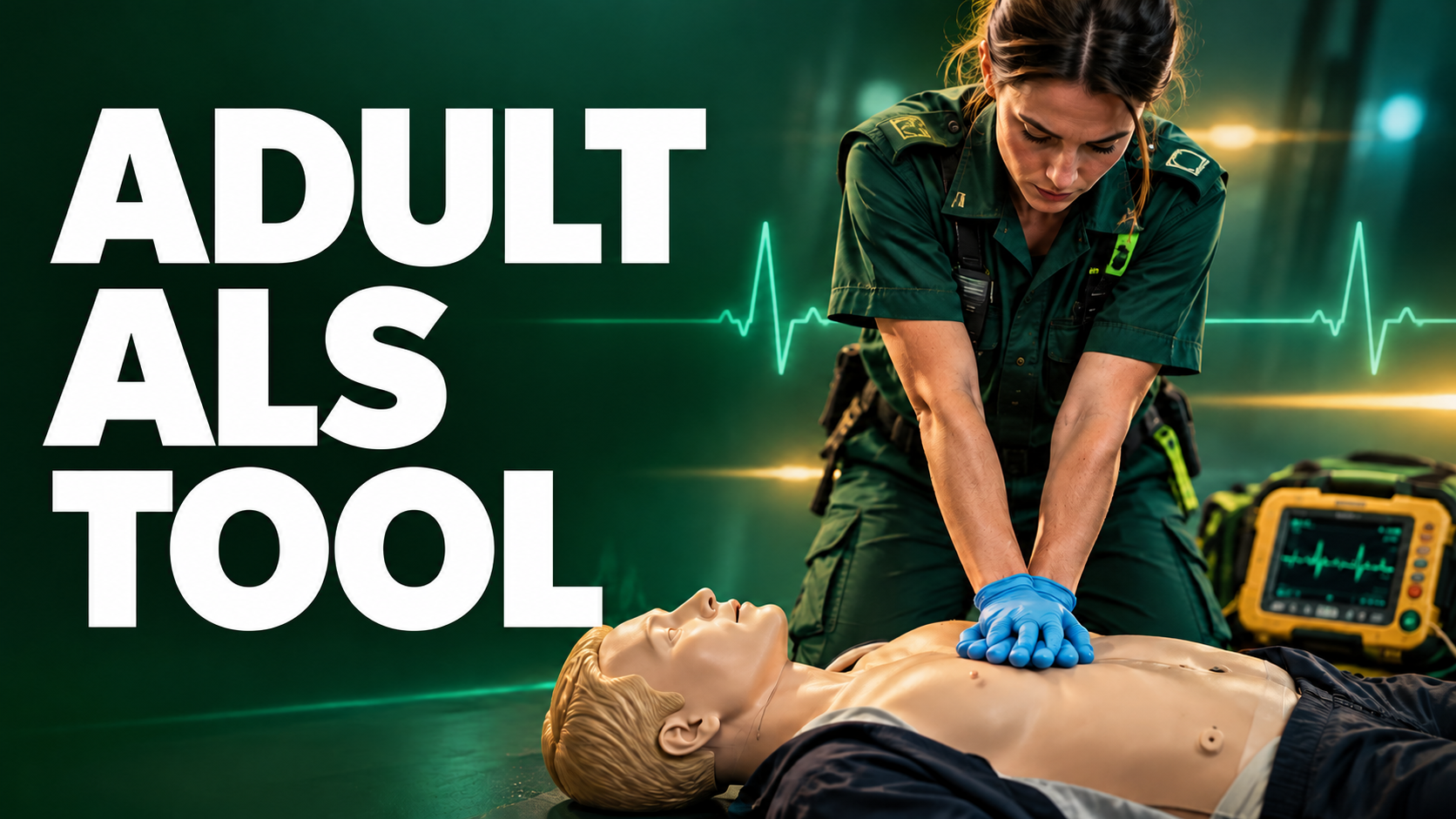
Adult Advanced Life Support 2025 Interactive Flowchart
Interactive adult ALS training: follow the pathway, practise team tasks and record a fictional scenario.
Main algorithm
Arrest duration timer
CPR timer
Adrenaline timer
Adrenaline prompt
Amiodarone prompt
Arrest tracker
During CPR checklist
Reversible causes
Post-ROSC Care — Interactive ABCDE Pathway
Prehospital education · sources checked 18 October 2026
Scenario setup
The reminder is a training aid, not a prescribed clinical interval. Reassess continuously and whenever the patient changes. A low early neurological score does not establish prognosis.
Main pathway
Time since ROSC
Training reassessment
Not running
Current targets
Review tracker
0
Care targets and interpretation
ETCO₂ is an end-tidal measurement. It is not interchangeable with arterial PaCO₂. Use waveform quality, trends and blood gases where available.
Observations
No readings recorded.
Care checklist
Deterioration
Resume CPR immediately. Return to rhythm assessment with the same event log, shock and drug counts. Review previous treatment and the time since the last dose.
References and scope
RCUK Adult post-resuscitation care 2025 and Paediatric life support 2025: prehospital post-resuscitation care.
Child blood-pressure comparison requires an age-specific reference supplied by the clinician; adult thresholds are never applied to children. This prehospital support tool excludes ICU prescribing, invasive treatment selection, automated cooling, prognostication and withdrawal decisions. Special circumstances require individualised targets.
Sources checked 18 October 2026. Current licensed JRCALC content has not been independently verified. Scenario data remains in page memory and is lost on refresh. Logs contain fictional training entries, not a clinical record.
Event log
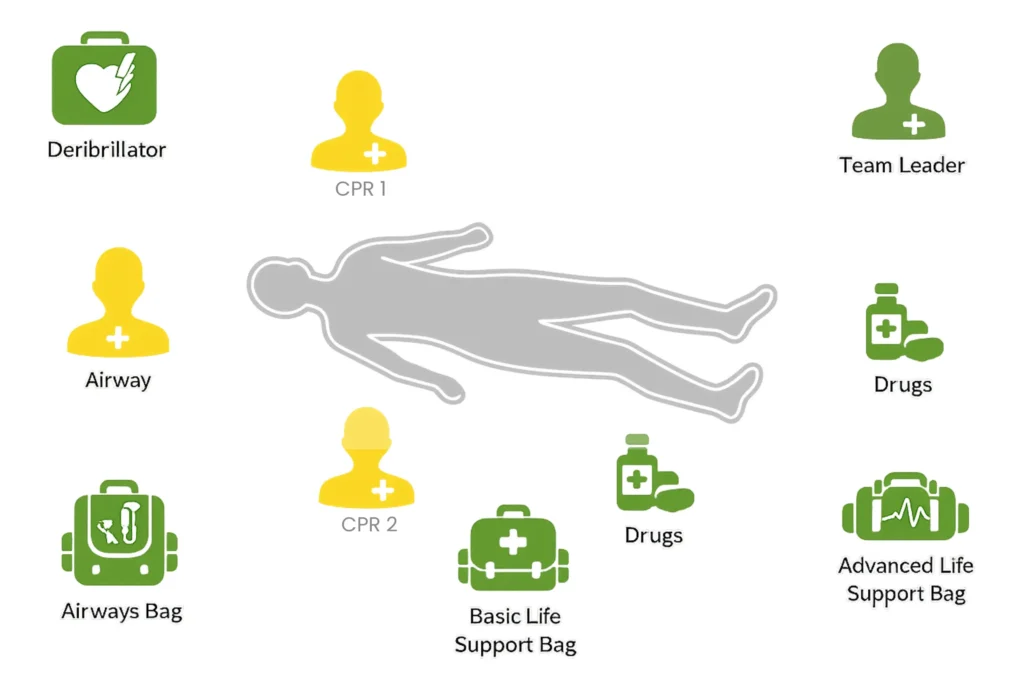
PitStop Layout
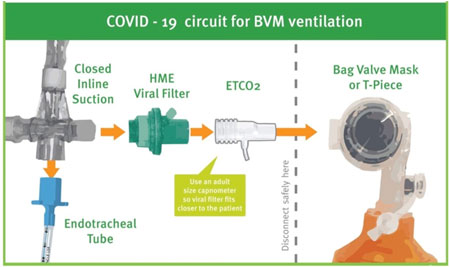
Airway Circuit
RCUK Adult Advanced Life Support guideline (2025). Checked 17 October 2026. Educational reproduction; no clinical validation or RCUK endorsement is claimed. Special circumstances need separate guidance.
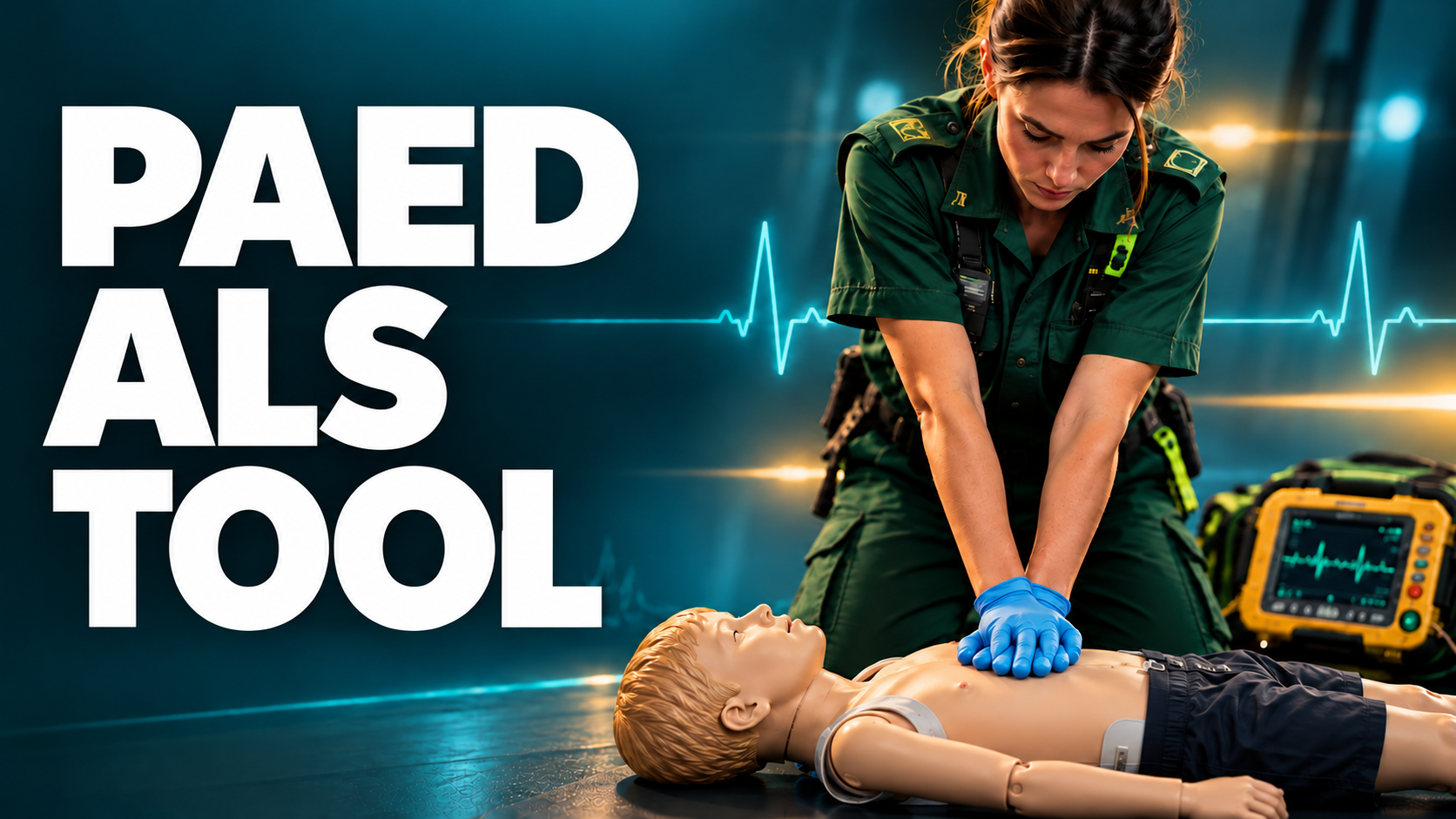
Interactive Paediatric Advanced Life Support
FLOW
Recognise cardiac arrest
Unresponsive and not breathing normally, or only occasional gasps.
Weight and shock calculation
Call for help
Activate resuscitation team. Allocate roles early.
Start CPR
5 initial rescue breaths, then 15:2. Attach defibrillator or monitor.
Assess rhythm
Choose shockable, non-shockable, or ROSC.
Shockable
VF or pulseless VT
Give 1 shock
4 J kg-1
Immediately resume CPR
2 minutes. Minimise interruptions.
Return of spontaneous circulation
Move to post cardiac arrest care.
Post cardiac arrest care
ABCDE, oxygenation, ventilation, investigations, treat cause, temperature control.
Non-shockable
PEA/asystole; HR below 60/min with poor perfusion despite adequate respiratory support.
Immediately resume CPR
2 minutes. Give adrenaline as soon as possible via drug prompt.
Current instruction
CPR cycle timer
Rhythm selection is locked until the timer ends.
Adrenaline timer
Shockable: after the 3rd shock.
Then every 3 to 5 minutes. Dose:
Enter weight
First dose after the 3rd shock.
Second dose after the 5th shock (maximum 150 mg). Dose:
Enter weight
Arrest tracker
During CPR checklist
Reversible causes
Post-ROSC Care — Interactive ABCDE Pathway
Prehospital education · sources checked 18 October 2026
Scenario setup
The reminder is a training aid, not a prescribed clinical interval. Reassess continuously and whenever the patient changes. A low early neurological score does not establish prognosis.
Main pathway
Time since ROSC
Training reassessment
Not running
Current targets
Review tracker
0
Care targets and interpretation
ETCO₂ is an end-tidal measurement. It is not interchangeable with arterial PaCO₂. Use waveform quality, trends and blood gases where available.
Observations
No readings recorded.
Care checklist
Deterioration
Resume CPR immediately. Return to rhythm assessment with the same event log, shock and drug counts. Review previous treatment and the time since the last dose.
References and scope
RCUK Adult post-resuscitation care 2025 and Paediatric life support 2025: prehospital post-resuscitation care.
Child blood-pressure comparison requires an age-specific reference supplied by the clinician; adult thresholds are never applied to children. This prehospital support tool excludes ICU prescribing, invasive treatment selection, automated cooling, prognostication and withdrawal decisions. Special circumstances require individualised targets.
Sources checked 18 October 2026. Current licensed JRCALC content has not been independently verified. Scenario data remains in page memory and is lost on refresh. Logs contain fictional training entries, not a clinical record.
Event log
Reset
Use this to clear the event log, current scenario, timers, drug counts, shock counts, reversible causes, BM, temperature and weight entry.
PitStop Layout
Airway Circuit
Body Weight Avg Estimate
Reference estimates reproduced from the EMSUK page. Original centile source is not stated. These values do not populate the calculator. Use a measured or reliably reported weight wherever possible.
Boys
| Age | 25th (kg / st‑lb) | 50th (kg / st‑lb) | 75th (kg / st‑lb) |
|---|---|---|---|
| 1 | 9.0 kg (1st 6 lb) | 10.0 kg (1st 8 lb) | 11.0 kg (1st 11 lb) |
| 2 | 11.5 kg (1st 11 lb) | 12.5 kg (1st 13 lb) | 13.5 kg (2st 2 lb) |
| 3 | 13.5 kg (2st 2 lb) | 14.5 kg (2st 4 lb) | 16.0 kg (2st 7 lb) |
| 4 | 15.0 kg (2st 5 lb) | 16.5 kg (2st 8 lb) | 18.0 kg (2st 11 lb) |
| 5 | 17.0 kg (2st 10 lb) | 18.5 kg (2st 13 lb) | 20.5 kg (3st 3 lb) |
| 6 | 18.5 kg (2st 13 lb) | 20.5 kg (3st 3 lb) | 22.5 kg (3st 8 lb) |
| 7 | 20.5 kg (3st 3 lb) | 22.5 kg (3st 8 lb) | 25.0 kg (3st 13 lb) |
| 8 | 23.0 kg (3st 8 lb) | 25.5 kg (4st 0 lb) | 28.0 kg (4st 6 lb) |
| 9 | 25.5 kg (4st 0 lb) | 28.5 kg (4st 7 lb) | 31.5 kg (4st 13 lb) |
| 10 | 28.5 kg (4st 7 lb) | 32.0 kg (5st 0 lb) | 35.5 kg (5st 8 lb) |
| 11 | 32.0 kg (5st 0 lb) | 36.0 kg (5st 9 lb) | 40.0 kg (6st 4 lb) |
| 12 | 36.0 kg (5st 9 lb) | 40.5 kg (6st 5 lb) | 45.0 kg (7st 1 lb) |
| 13 | 41.0 kg (6st 6 lb) | 46.0 kg (7st 3 lb) | 51.0 kg (8st 0 lb) |
| 14 | 46.0 kg (7st 3 lb) | 51.0 kg (8st 0 lb) | 56.5 kg (8st 12 lb) |
| 15 | 51.0 kg (8st 0 lb) | 57.0 kg (8st 13 lb) | 63.0 kg (9st 13 lb) |
| 16 | 55.0 kg (8st 9 lb) | 61.0 kg (9st 8 lb) | 68.0 kg (10st 10 lb) |
Girls
| Age | 25th (kg / st‑lb) | 50th (kg / st‑lb) | 75th (kg / st‑lb) |
|---|---|---|---|
| 1 | 8.5 kg (1st 5 lb) | 9.5 kg (1st 7 lb) | 10.5 kg (1st 10 lb) |
| 2 | 11.0 kg (1st 11 lb) | 12.0 kg (1st 13 lb) | 13.0 kg (2st 1 lb) |
| 3 | 12.8 kg (2st 0 lb) | 14.0 kg (2st 3 lb) | 15.5 kg (2st 6 lb) |
| 4 | 14.5 kg (2st 4 lb) | 16.0 kg (2st 7 lb) | 17.8 kg (2st 11 lb) |
| 5 | 16.5 kg (2st 9 lb) | 18.5 kg (2st 13 lb) | 20.5 kg (3st 3 lb) |
| 6 | 18.5 kg (2st 13 lb) | 20.5 kg (3st 3 lb) | 22.8 kg (3st 8 lb) |
| 7 | 20.5 kg (3st 3 lb) | 23.0 kg (3st 8 lb) | 25.5 kg (4st 0 lb) |
| 8 | 23.0 kg (3st 8 lb) | 26.0 kg (4st 1 lb) | 29.0 kg (4st 8 lb) |
| 9 | 26.0 kg (4st 1 lb) | 29.5 kg (4st 9 lb) | 33.0 kg (5st 3 lb) |
| 10 | 29.5 kg (4st 9 lb) | 33.5 kg (5st 4 lb) | 38.0 kg (5st 13 lb) |
| 11 | 33.5 kg (5st 4 lb) | 38.5 kg (6st 1 lb) | 44.0 kg (6st 13 lb) |
| 12 | 38.5 kg (6st 1 lb) | 44.0 kg (6st 13 lb) | 50.0 kg (7st 12 lb) |
| 13 | 44.0 kg (6st 13 lb) | 49.5 kg (7st 11 lb) | 55.5 kg (8st 11 lb) |
| 14 | 48.0 kg (7st 8 lb) | 53.0 kg (8st 5 lb) | 59.5 kg (9st 5 lb) |
| 15 | 50.0 kg (7st 12 lb) | 55.0 kg (8st 9 lb) | 62.0 kg (9st 11 lb) |
| 16 | 52.0 kg (8st 3 lb) | 57.0 kg (8st 13 lb) | 65.0 kg (10st 3 lb) |
Clinical reference: Resuscitation Council UK: Paediatric Life Support (2025). Source checked 17 October 2026. The second amiodarone dose is capped at 150 mg, following the guideline narrative. This educational reproduction is not clinically validated or endorsed by RCUK. Special circumstances require separate guidance.
Drowning — Interactive Resuscitation Flowchart
Adult and child training pathway · RCUK 2025 · sources checked 18 October 2026
Scenario setup and observations
No observations recorded. Do not delay rescue breaths or CPR to obtain a reading.
Main algorithm
Arrest elapsed
No automatic stopping threshold.
CPR timer
Not running
Adrenaline timer
Interval follows temperature.
Adrenaline
Amiodarone
Arrest tracker
During rescue and CPR
Circulation present / after ROSC
JRCALC’s 15 April 2026 public update adds immersion pulmonary oedema. Consult its current licensed guidance for diagnosis and management.
Event log
References, hypothermia rules and scope
RCUK Special circumstances (2025), Paediatric life support (2025) and Adult ALS (2025).
JRCALC Drowning update, 15 April 2026: public change notice only; full licensed protocol not verified. No JRCALC or RCUK endorsement or clinical validation is claimed.
Adult hypothermia: this implementation follows the RCUK website’s adrenaline threshold of 30°C. The ERC 2025 PDF describes a possible single lower-temperature dose when ECPR is delayed; resolve this difference using current local guidance. No such exception is automated here.
Unknown temperature is not assumed normal. Rescue breaths and CPR remain available; initial shocks are supported, but further shocks and drugs require a thermal assessment. For children, drugs also require a valid weight. Input bounds are plausibility checks, not diagnostic thresholds.
Advanced-airway ventilation, refractory shock energy escalation, newborn transition, diving emergencies, intermittent CPR, rescue withdrawal and termination decisions require their separate current protocols. This tool does not calculate those decisions or transfer state to the other sections.
Anaphylaxis — Interactive Treatment Pathway
Prehospital education · sources checked 18 October 2026
Scenario setup
Sudden ABC compromise can occur without a rash. Skin symptoms alone do not establish anaphylaxis. Give indicated treatment promptly; do not wait to finish every checklist item.
Main pathway
Scenario elapsed
IM dose interval
Not running
IM adrenaline reference
Treatment tracker
0
Oxygen, fluids and escalation
Give high-concentration oxygen initially. Titrate towards SpO₂ 94–98% when feasible; consider 88–92% for patients at risk of hypercapnic respiratory failure. Support inadequate ventilation.
IV adrenaline for a patient with circulation requires an appropriately experienced specialist. This tool does not calculate an IV infusion or suggest IV boluses. Antihistamines do not treat ABC compromise; steroids are not routine initial treatment.
Observations
No readings recorded.
Care checklist
Deterioration
Start CPR immediately if indicated. Use the relevant Adult ALS or Paed ALS section; check its scenario state before using it. No clinical state is automatically transferred.
Event log
References and scope
RCUK Emergency treatment of anaphylactic reactions — May 2021, with its initial and refractory algorithms. This remains the latest dedicated version listed by RCUK when checked 18 October 2026.
Infants under six months require an explicit 100 or 150 microgram choice against local guidance. Dose-volume figures apply only to 1 mg/mL adrenaline for IM administration. These are age-band references; no specialist IV-adrenaline calculation, auto-injector substitution, previous-dose import or discharge decision is automated.
Sources checked 18 October 2026. Current licensed JRCALC content has not been independently verified. Scenario data remains in page memory and is lost on refresh. Logs contain fictional training entries, not a clinical record.
Quick Overview
- 1 minute read
- Intermediate level
- Updated 18 Oct 2026