

A millar badge was a type of badge worn by ambulance staff in the United Kingdom during World War II. It was named after Sir James Millar, who was responsible for organizing the wartime ambulance service.
The badge was a circular metal disc, usually made of brass or copper, and about the size of a penny. It featured an embossed design of a running horse, with the words “Ambulance Service” around the edge. The badge was worn on the lapel of the ambulance staff’s uniform and was used to identify them as members of the ambulance service.
During World War II, the millar badge became a symbol of pride and dedication for ambulance staff who worked tirelessly to transport wounded soldiers and civilians to hospitals and medical facilities. It was also a symbol of the bravery and selflessness of these men and women, who often worked under dangerous and difficult conditions.
It’s worth noting that while the millar badge was typically worn on the lapel of an ambulance staff’s uniform, some versions of the badge were designed to be worn on the sleeve instead. These sleeve badges were typically larger and more elaborate than the lapel badges and were often made of embroidered cloth rather than metal.
Sleeve badges were sometimes used to indicate a particular rank or role within the ambulance service, such as a senior paramedic or a driver. They could also be used to indicate a specific area of expertise, such as a specialist in treating burns or respiratory distress.
Overall, the design and placement of ambulance service badges varied depending on the country and time period in question, as well as the specific role and responsibilities of the wearer.
The use of the Millar badge in the United Kingdom ended with the conclusion of World War II in 1945. As the war ended, the ambulance service was restructured and many of the personnel who had served during the war returned to civilian life. The Miller badge was no longer required, and it gradually fell out of use.
However, in more recent times, the Millar badge has been revived as a symbol of the history and tradition of the ambulance service. Some modern ambulance services in the UK have chosen to adopt the Millar badge as a way of paying tribute to the service’s wartime roots and to honor the sacrifices made by ambulance staff during the war. In these cases, the badge may be worn as part of a ceremonial uniform or as a lapel pin. However, in more recent years, it has again disappeared from Ambulance Uniforms. Hopefully, it will one day return. I was proud to wear mine on my uniform.
Some additional information 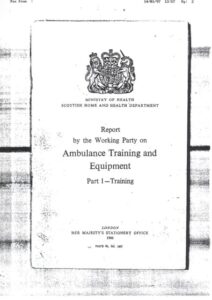 has been sent in by Michael