








Code 1 vs Code 2 Stroke: How Stroke Pathways Work for UK Paramedics (NICE & JRCALC Explained)
Understanding Stroke Pathways for Ambulance Crews and Hospitals
If you work in ambulance services or emergency departments, you may hear terms such as Code 1 stroke or Code 2 stroke. These are commonly used in local stroke pathways to prioritise suspected stroke patients. However, an important starting point is this:
NICE and JRCALC do not formally define “Code 1” and “Code 2” strokes.
Instead, these codes are local operational systems used by hospitals and ambulance services to prioritise suspected stroke patients based on the likelihood of hyperacute treatment eligibility.
The clinical framework guiding stroke care in the UK comes primarily from:
-
NICE Guideline NG128 – Stroke and TIA in over 16s
-
JRCALC Clinical Guidelines for UK Ambulance Services
Understanding how stroke coding works requires looking at how suspected stroke is recognised, prioritised, and transported within the stroke pathway.
1. Stroke Recognition in Prehospital Care
The first step in the stroke pathway occurs before the patient reaches the hospital.
Both NICE and JRCALC recommend using a validated stroke recognition tool, most commonly the FAST test.
FAST stands for:
-
Face – facial droop or asymmetry
-
Arm – arm weakness
-
Speech – slurred or abnormal speech
-
Time – urgent medical assessment required
Paramedics use FAST to rapidly identify possible stroke in the community.
NICE also states that clinicians should exclude hypoglycaemia as a cause of neurological symptoms, which is why ambulance crews routinely check blood glucose during stroke assessments.
Once stroke is suspected, the focus shifts to time-critical decision making.
2. Why Stroke Pathways Prioritise Patients
Stroke treatment is highly time-dependent.
For acute ischaemic stroke, treatment options may include:
-
Intravenous thrombolysis
-
Mechanical thrombectomy
Thrombolysis is generally recommended within 4.5 hours of symptom onset, once intracranial haemorrhage has been excluded on imaging.
Because of this narrow treatment window, stroke systems are designed to:
-
Identify stroke quickly
-
Transport patients rapidly
-
Prioritise those who may benefit from reperfusion therapy
This is where stroke coding systems come into play.
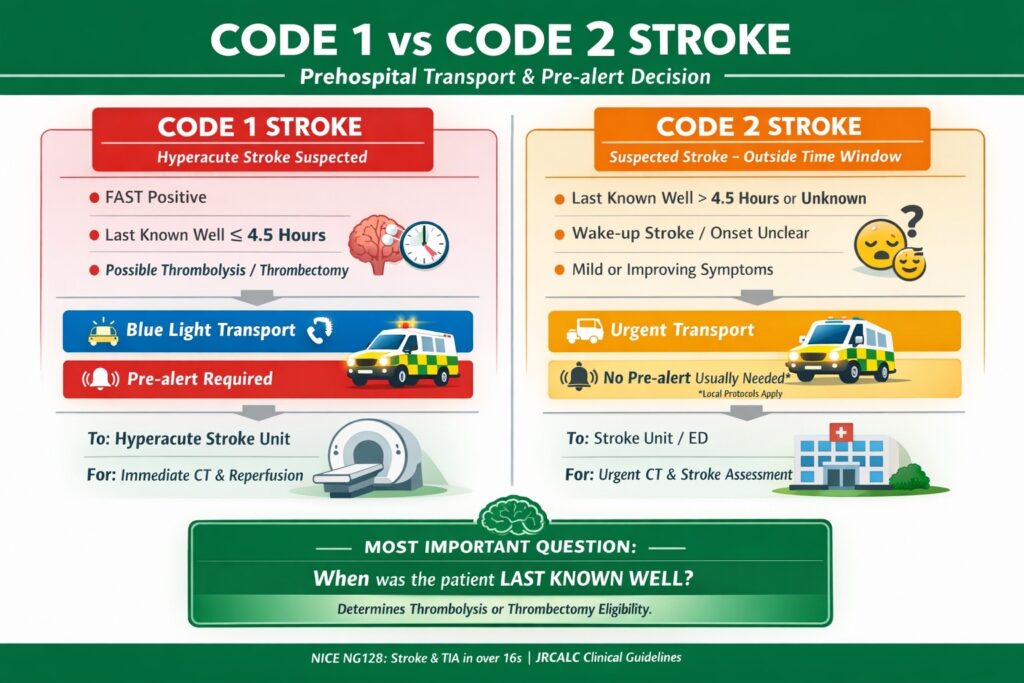
3. Code 1 Stroke (Hyperacute Stroke Alert)
In many hospital pathways, Code 1 stroke refers to a suspected acute stroke within the potential treatment window.
This means the patient may still be eligible for hyperacute interventions.
Typical features of a Code 1 stroke include:
-
FAST positive
-
Last Known Well within approximately 4.5 hours
-
Significant neurological deficit
-
No obvious contraindication to thrombolysis
When a Code 1 stroke is identified, hospitals usually activate a hyperacute stroke response.
This may include:
-
Immediate notification of the stroke team
-
Rapid transfer to CT scanning
-
Urgent clinical assessment
-
Decision regarding thrombolysis or thrombectomy
Many hospitals aim for:
-
Door-to-CT time under 20 minutes
-
Door-to-needle thrombolysis within 60 minutes
These time targets exist because earlier treatment leads to better outcomes.
4. Code 2 Stroke (Suspected Stroke Outside Hyperacute Window)
A Code 2 stroke generally refers to a patient with suspected stroke who is less likely to receive immediate reperfusion therapy.
This usually occurs when:
-
Last Known Well is more than 4.5 hours
-
The onset time is unknown
-
The patient woke up with symptoms
-
Symptoms are mild or improving
These patients still require urgent assessment and imaging, but they may not trigger the same hyperacute response as Code 1 patients.
Typical management includes:
-
CT brain imaging
-
Stroke team review
-
Admission to a stroke unit
-
Secondary prevention and rehabilitation planning
Importantly, being Code 2 does not mean the stroke is less serious. It simply reflects the likelihood of immediate reperfusion therapy.
5. The Role of Ambulance Clinicians
JRCALC emphasises that the role of ambulance clinicians is to:
-
Recognise suspected stroke quickly
-
Perform a structured assessment
-
Transport patients rapidly to an appropriate stroke centre
-
Provide early hospital notification where appropriate.
Key pieces of information provided during a stroke pre-alert usually include:
-
FAST findings
-
Last Known Well
-
Blood glucose
-
Anticoagulant medication
-
Level of consciousness
These details help hospitals determine the stroke pathway activation level.
6. Hyperacute Stroke Units (HASUs)
Many areas of the UK use Hyperacute Stroke Units (HASUs).
These specialist centres provide:
-
24-hour stroke specialist care
-
Rapid brain imaging
-
Thrombolysis capability
-
Access to thrombectomy referral pathways
Ambulance services may bypass closer hospitals to reach a HASU, depending on local stroke network protocols.
Local arrangements determine these pathways and bypass decisions.
7. The Most Important Question in Stroke Care
Across the entire stroke pathway, one question is critical:
“When was the patient last known well?”
This determines whether the patient may still be eligible for time-critical treatment.
If the time of onset is unclear, clinicians may treat the patient as outside the thrombolysis window until imaging clarifies eligibility.
8. Why Stroke Coding Systems Exist
Stroke codes such as Code 1 and Code 2 exist primarily to:
-
Prioritise CT scanning
-
Mobilise stroke teams quickly
-
Identify patients who may benefit from hyperacute treatment
-
streamline hospital workflow
However, it is important to remember that coding terminology varies between hospitals and ambulance services.
The underlying clinical decisions remain based on national guidelines and stroke pathway principles.
Accuracy Check (UK Practice Review)
This article has been reviewed against current UK stroke guidance.
✔ FAST screening tool recommended by NICE
✔ Hypoglycaemia exclusion recommended by NICE
✔ Thrombolysis window approximately 4.5 hours
✔ Prehospital stroke recognition responsibility described in JRCALC
✔ Hyperacute stroke unit pathways are common across UK stroke networks
✔ Code 1 / Code 2 terminology identified as local operational practice rather than national definitions
These points align with:
-
NICE NG128 Stroke and TIA guideline
-
JRCALC Clinical Guidelines
-
UK national stroke service models
References
NICE. (2019). Stroke and transient ischaemic attack in over 16s: diagnosis and initial management (NG128).
NICE. (2019). Recommendations – rapid recognition of stroke symptoms.
Joint Royal Colleges Ambulance Liaison Committee. JRCALC Clinical Guidelines.
Intercollegiate Stroke Working Party. National Clinical Guideline for Stroke.
Stroke Association. Ambulance response to stroke.

CPD Log Entry
Article: How Stroke Coding Works in the UK – Code 1 vs Code 2 Stroke
What?
I reviewed an article explaining how suspected strokes are prioritised within UK stroke pathways, particularly the operational use of Code 1 and Code 2 stroke alerts. The article clarified that these codes are not defined nationally by NICE or JRCALC but are commonly used locally by hospitals to prioritise patients based on the likelihood of hyperacute treatment eligibility.
The article reinforced that the FAST assessment is recommended by NICE for rapid stroke recognition and that clinicians must also exclude hypoglycaemia as a potential cause of neurological symptoms. Once stroke is suspected, ambulance clinicians should focus on determining the time the patient was last known well, as this is a key factor in determining eligibility for treatments such as intravenous thrombolysis, which is generally recommended within 4.5 hours of symptom onset once intracranial haemorrhage has been excluded.
The article also described how Code 1 stroke is commonly used to identify patients within the potential hyperacute treatment window who require rapid transport, stroke team activation, and immediate CT imaging. Code 2 stroke typically refers to patients who are suspected of having a stroke but are outside the thrombolysis window or have an uncertain onset time. These patients still require urgent imaging and specialist stroke assessment but may not trigger the same level of immediate response.
So What?
This reinforced the importance of gathering accurate clinical information early in the patient assessment. In practice, the most critical question when assessing a suspected stroke is determining the time the patient was last known well, not simply when symptoms were first noticed.
Accurate identification of this time directly affects whether the patient may be eligible for hyperacute stroke treatment, including thrombolysis or referral for thrombectomy. As ambulance clinicians are often the first healthcare professionals to assess the patient, the information we provide during a hospital pre-alert can significantly influence the stroke pathway that is activated.
The article also highlighted that stroke coding systems such as Code 1 and Code 2 are primarily operational tools used to prioritise resources, rather than formal clinical definitions. This is useful to understand when communicating with different hospitals, as terminology and pathways may vary slightly between regions.
Now What?
Following this learning, I will ensure that when assessing suspected stroke patients I prioritise identifying and documenting the last known well time as accurately as possible. I will also ensure that my pre-alerts include key information that stroke teams rely on, including FAST findings, blood glucose results, and relevant medication history such as anticoagulant use.
Understanding the purpose of stroke coding systems also helps improve communication with receiving hospitals and ensures that patients who may benefit from hyperacute treatment are transported rapidly and managed appropriately.
Estimated Time: to read, digest and review related guidance:
30 minutes
Quick Overview
- 7 minute read
- Intermediate level
- Updated 11 Mar 2026
Key Learning Points
- Understanding Stroke Pathways for Ambulance Crews and Hospitals
- CPD Log Entry
- What?
- So What?
- Now What?
Finished this article?
Mark it as read to record your progress and collect learning points.
Self-reported reading. This does not complete a CPD reflection.Checking your reading progress…