

Overview
This is a purpose-built UK pharmacology text written specifically for paramedics, student paramedics and prehospital clinicians. It avoids the generic medical-school approach and instead focuses on the medicines actually used in UK ambulance practice, framed around JRCALC, medicine law, PGDs and real clinical decision-making.
The book is split into two clear sections:
- Section A – Core pharmacological principles (medicines law, routes of administration, pharmacokinetics, pharmacodynamics, adverse drug reactions).
- Section B – An A–Z of the key JRCALC medicines (Adrenaline, Amiodarone, Aspirin, Atropine, Morphine, Naloxone, TXA, Penthrox, GTN, Salbutamol, etc.), with pharmacokinetics, pharmacodynamics, clinical use and case studies for each.
Full-colour diagrams, realistic case studies and clear explanations of the “why” behind each drug make it particularly useful for students and newly qualified paramedics.

A genuinely useful, well-targeted book that fills a clear gap. Most pharmacology texts are either too hospital-focused or too superficial. This one sits in the sweet spot for UK paramedics, scientifically sound, practically relevant,…
Overview
This is a purpose-built UK pharmacology text written specifically for paramedics, student paramedics and prehospital clinicians. It avoids the generic medical-school approach and instead focuses on the medicines actually used in UK ambulance practice, framed around JRCALC, medicine law, PGDs and real clinical decision-making.
The book is split into two clear sections:
Section A – Core pharmacological principles (medicines law, routes of administration, pharmacokinetics, pharmacodynamics, adverse drug reactions).
Section B – An A–Z of the key JRCALC medicines (Adrenaline, Amiodarone, Aspirin, Atropine, Morphine, Naloxone, TXA, Penthrox, GTN, Salbutamol, etc.), with pharmacokinetics, pharmacodynamics, clinical use and case studies for each.
Full-colour diagrams, realistic case studies and clear explanations of the “why” behind each drug make it particularly useful for students and newly qualified paramedics.
Detailed Review & Ratings
Open a criterion to read the full rationale behind the score.
Clinical Relevance9/10Directly mapped to the medicines paramedics actually carry and administer. Strong coverage of JRCALC drugs, special populations and…⌄
Directly mapped to the medicines paramedics actually carry and administer. Strong coverage of JRCALC drugs, special populations and concurrent medical conditions. Feels written by people who understand the prehospital environment
Pre-Hospital Relevance9/10Excellent. Case studies reflect real ambulance scenarios rather than hospital ward examples. Legal framework (medicines law + PGDs)…⌄
Excellent. Case studies reflect real ambulance scenarios rather than hospital ward examples. Legal framework (medicines law + PGDs) is practical and UK-specific
Clinical Reasoning8.5/10Goes beyond “give this dose for this indication”. Explains mechanisms, individual variation and decision-making factors so readers understand…⌄
Goes beyond “give this dose for this indication”. Explains mechanisms, individual variation and decision-making factors so readers understand why a drug works (or doesn’t) in a given patient.
Ease of Use / Structure8.5/10Clear two-section layout. The A–Z section is easy to dip into for revision or quick reference. Diagrams help…⌄
Clear two-section layout. The A–Z section is easy to dip into for revision or quick reference. Diagrams help visual learners. Slightly more academic in tone in Section A, but still accessible.
Reference Quality8/10Aligned with current UK guidance and JRCALC at the time of writing. Glossary and index are useful. As…⌄
Aligned with current UK guidance and JRCALC at the time of writing. Glossary and index are useful. As with any print drug text, users will still need the latest JRCALC app/iCPG for dose updates.
Value for Money8.5/1036.99 is reasonable for a specialist text of this quality. Better value than many generic pharmacology books that…⌄
36.99 is reasonable for a specialist text of this quality. Better value than many generic pharmacology books that contain large amounts of irrelevant hospital content.
⚑ EMSUK Verdict
A genuinely useful, well-targeted book that fills a clear gap. Most pharmacology texts are either too hospital-focused or too superficial. This one sits in the sweet spot for UK paramedics, scientifically sound, practically relevant, and written by people who understand the job.
Highly recommended for students and NQPs. Experienced clinicians will also find the deeper explanations and case studies valuable for CPD and teaching.
Who should choose this?
- ✓ Student paramedics (especially those on pharmacology modules)
- ✓ Newly Qualified Paramedics consolidating knowledge
- ✓ Practising paramedics wanting structured CPD or a deeper understanding of the drugs they give daily Educators looking for a UK-focused teaching resource Anyone preparing for prescribing qualifications who needs solid foundational knowledge
Who should skip it?
- × Clinicians who only want a pure dose/indication quick-reference card (use the JRCALC app instead)
- × Those already very confident with both the science and the legal framework of UK paramedic medicines
Review details
- Review date
- 11/10/2026
- Last updated
- 11/10/2026
- Clinically checked
- ✓ Yes — JrCalc and NICE Guidelibnes
- Review method
- Hands On
- Reviewer
- EMSUK Learning — Steve Hutchinson
- Confidence
- High
Alternatives you might like
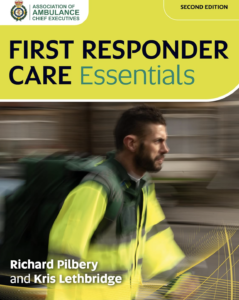 First Responder Care Essentials, Second Edition
Finished this article?
Mark it as read to record your progress and collect learning points.
Self-reported reading. This does not complete a CPD reflection.