Introduction: A National Crisis at the Kerbside
Opioid Use Disorder (OUD) is not just a problem—it’s a public health emergency that paramedics face daily in the UK. The people we encounter—unresponsive in shop doorways, convulsing in back alleys, or sobbing in withdrawal—are the faces behind the statistics.
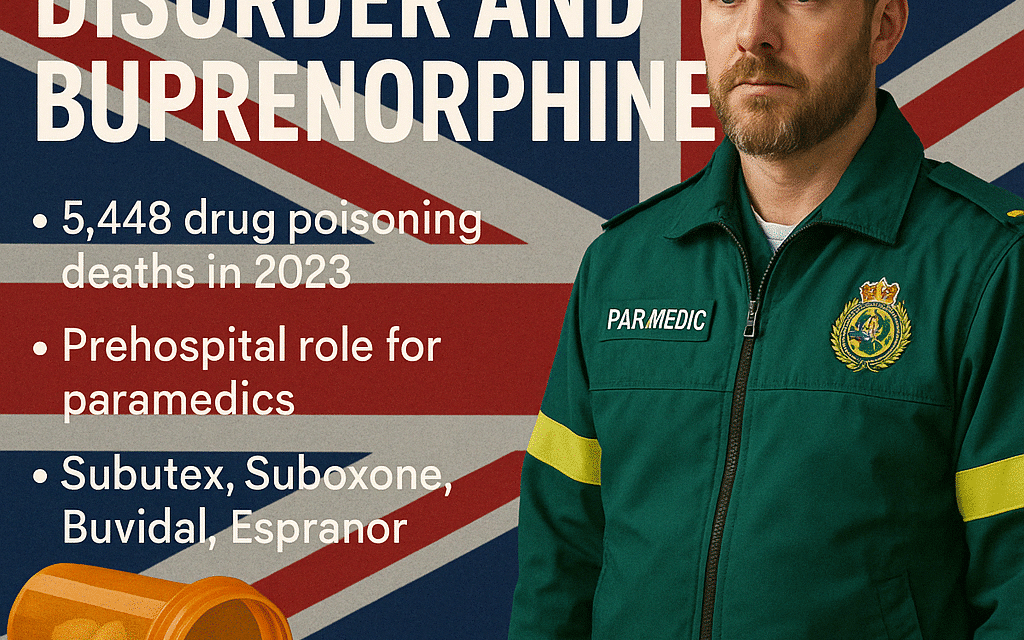
In England and Wales, the Office for National Statistics (ONS) reported 5,448 drug poisoning deaths in 2023, the highest since records began. Of these, 46.8% involved opiates, such as heroin and morphine. Meanwhile, Scotland continues to report the highest drug-related death rate in Europe, with 1,172 deaths in 2023, and opioids implicated in 80% of these cases.
It’s clear: our current response model—primarily resuscitative, transport-based, and fragmented—isn’t enough. But there’s a shift underway, and at the centre of that shift is Buprenorphine, a medication that has the potential to fundamentally change how paramedics manage opioid dependency in the field.
Understanding Opioid Use Disorder (OUD)
OUD is a chronic, relapsing disorder marked by a compulsive urge to use opioids despite harmful consequences. It affects brain chemistry, particularly the reward and decision-making centres. This is not a moral failing—it’s a medical condition.
The UK Home Office estimates over 260,000 adults in England use heroin and/or crack cocaine, with many living with comorbid mental health issues, homelessness, or trauma. OUD is particularly prevalent in deprived communities—areas where paramedics are called repeatedly for the same individuals caught in cycles of overdose and withdrawal.
Buprenorphine: A Game-Changer in the Prehospital Setting
Buprenorphine is a partial opioid agonist, meaning it activates opioid receptors just enough to prevent withdrawal and reduce cravings, but without delivering the euphoric high of heroin or full agonists like methadone. It’s also remarkably safe in overdose, thanks to its “ceiling effect”—higher doses don’t lead to proportionally higher opioid effects, limiting respiratory depression.
Alternative Names and Formulations of Buprenorphine:
-
Subutex – Sublingual tablets with buprenorphine alone.
-
Suboxone – Combines buprenorphine with naloxone to deter misuse via injection.
-
Buvidal – A long-acting, injectable form (weekly or monthly), increasingly used in community detox programs.
-
Espranor – An orodispersible wafer that dissolves quickly in the mouth, improving compliance.
Each formulation has different uses in community and inpatient settings, and understanding these options is essential for meaningful paramedic engagement in care planning and patient communication.
Why Should Paramedics Care?
Because we’re not just the first point of contact—we’re often the only contact for people living with untreated OUD.
Traditional response models are reactive: administer naloxone, stabilise, transport or leave at scene. But that approach doesn’t interrupt the cycle. Buprenorphine offers a way to bridge acute crises with long-term solutions.
Some forward-thinking ambulance services, such as NEAS (North East Ambulance Service) and select pilot schemes in London, are exploring paramedic-administered Buprenorphine—either as on-scene withdrawal support, or immediate bridging therapy while patients are linked into same-day prescribing services.
Clinical Benefits of Buprenorphine in the Field
-
Rapid Withdrawal Relief
Buprenorphine reduces nausea, pain, anxiety, and diarrhoea—symptoms that often drive chaotic drug use. Its fast action makes it a compassionate and clinically sound choice for paramedics facing acute withdrawal cases. -
Bridge to Recovery
Administering Buprenorphine in the field creates a therapeutic window—giving the patient 24–72 hours of reduced cravings and stability, enough to engage with community recovery services or mental health teams. -
Reduced Risk of Overdose
Non-fatal overdoses are high-risk windows—many patients re-use immediately after naloxone reversal due to withdrawal onset. Buprenorphine reduces that compulsion and may be the key to preventing repeat calls and eventual fatalities.
Challenges and Considerations
1. Legal Authority and Governance
Currently, paramedics in the UK cannot prescribe controlled drugs, including Buprenorphine, unless they are also independent prescribers working under specific protocols. Use in the field is legally possible only under Patient Group Directions (PGDs) or research and pilot frameworks. National policies will need to adapt to enable wider paramedic involvement.
2. Precipitated Withdrawal
Giving Buprenorphine too soon after recent opioid use can trigger precipitated withdrawal—a sudden and intense reaction. Paramedics must be trained to identify appropriate administration windows (typically 6–12 hours post-last opioid use, depending on type) and screen for suitability.
3. Stigma and Cultural Shift
There remains stigma among clinicians and the public around OUD and its treatment. Viewing Buprenorphine as “just another opioid” misses the point—it’s a stabiliser, not a sedative. We need a professional culture that treats OUD as seriously and compassionately as any other chronic disease.
The Way Forward: A Role for Prehospital Addiction Medicine
This isn’t about making every paramedic an addiction specialist—but about empowering frontline clinicians with tools that can change the trajectory of care.
Imagine a system where:
-
Specialist paramedics have enhanced training in addiction medicine.
-
Buprenorphine is initiated on-scene under PGDs, with seamless electronic referral to recovery services.
-
Paramedics are a formal part of the addiction care continuum, not just acute crisis response.
This isn’t far-fetched. It’s already happening in parts of the US, Canada, and Australia—and some UK pilot sites are proving the model’s value.
Conclusion: From Resuscitation to Rehabilitation
OUD is a chronic medical condition. If we only show up to revive patients and walk away, we’re treating symptoms, not saving lives. Buprenorphine—whether as Subutex, Suboxone, Buvidal, or Espranor—is more than a drug. It’s a turning point. And paramedics can be the ones to offer it.
We’ve stepped up in mental health, sepsis care, and even palliative medicine. It’s time we do the same in addiction.
Let’s stop just reviving people—and start restoring them.