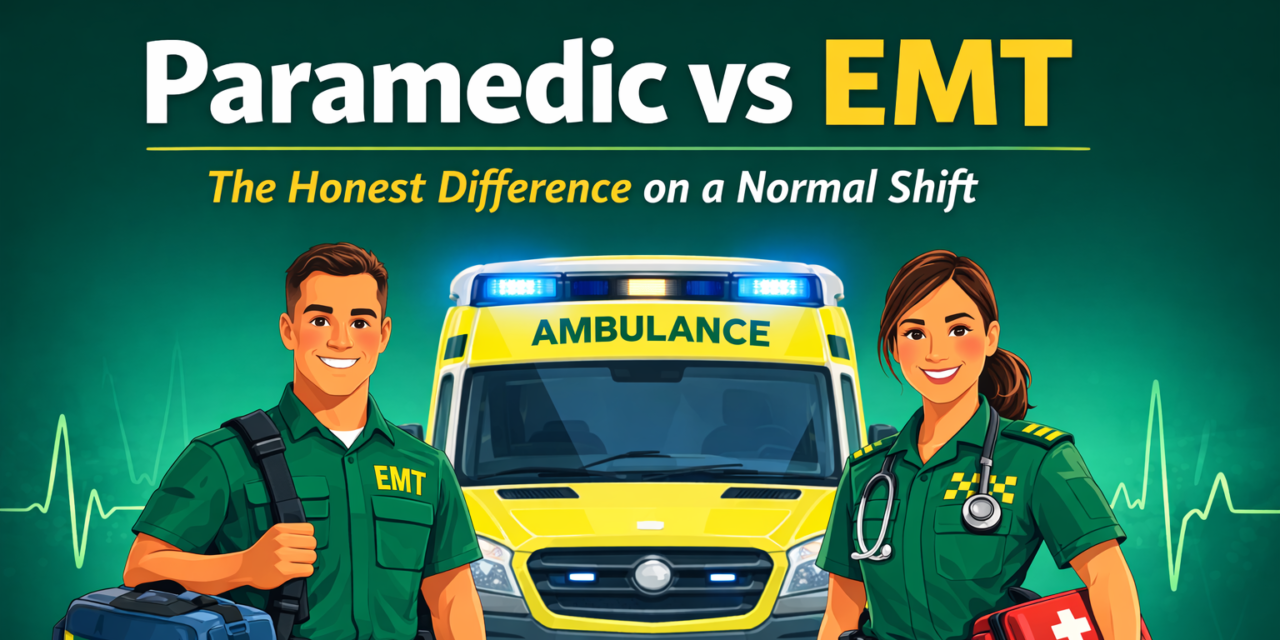
Spend enough time in ambulance stations and you will occasionally hear the quiet assumption that paramedics operate on a completely different level to Emergency Medical Technicians (EMTs). The reality, when you look at what actually happens on most shifts, is far more balanced.
This is not an attempt to diminish the paramedic role. Paramedics undergo more extensive education, carry greater clinical responsibility, and when critical incidents occur their training absolutely earns its place. When things become complicated or life-threatening, the paramedic’s knowledge, authority, and accountability matter enormously.
But if we step back and look honestly at the average day on the road, the difference between an experienced EMT and a paramedic is often smaller than people might expect.
What Most Ambulance Work Actually Looks Like
If you asked people outside the profession what ambulance crews deal with every day, they might picture major trauma, cardiac arrests, and dramatic life-saving interventions.
The reality is very different.
A typical shift is far more likely to involve:
-
Falls in elderly patients
-
Minor injuries
-
Abdominal pain
-
Shortness of breath
-
Mental health crises
-
Social care concerns
-
Alcohol intoxication
-
Non-specific illness
-
Chronic disease flare-ups
These are not rare calls. They are the backbone of ambulance workload.
In these everyday situations, EMTs and paramedics often perform very similar roles.
The Assessment Is Usually the Same
Whether the crew consists of a paramedic and EMT or two technicians, the first part of patient care rarely changes.
Both clinicians will:
-
Introduce themselves
-
Establish the patient’s main complaint
-
Take a clinical history
-
Record observations
-
Perform a physical assessment
These assessments follow structured clinical frameworks supported by guidance from organisations such as the Joint Royal Colleges Ambulance Liaison Committee and national clinical evidence from the National Institute for Health and Care Excellence.
In practice, an experienced EMT may have assessed thousands of patients over the course of their career. Recognising common presentations becomes second nature.
For many everyday problems, the EMT and paramedic often reach the same conclusion about what is going on.
Experience Matters More Than People Admit
An EMT with a decade of frontline experience may have attended:
-
Hundreds of chest pain calls
-
Hundreds of breathing problems
-
Large numbers of falls
-
Numerous diabetic emergencies
-
Endless cases of non-specific illness
That experience builds pattern recognition. Clinicians begin to recognise when something feels normal and when something does not.
Paramedics bring deeper academic knowledge of physiology, pharmacology, and pathology. That education becomes extremely important when a patient presents with complex or unclear illness.
But when the job is straightforward, experience frequently closes much of the gap between roles.
Where the Roles Actually Diverge
The main difference between EMTs and paramedics is not usually the assessment itself. It is clinical authority and responsibility.
Paramedics are trained and authorised to:
-
Administer a wider range of medications
-
Perform invasive procedures such as intravenous access
-
Interpret 12-lead ECGs
-
Make decisions about non-conveyance
-
Take overall responsibility for clinical management
Paramedics are also regulated professionals registered with the Health and Care Professions Council.
That responsibility carries weight.
If a patient deteriorates or a decision is questioned later, the paramedic must justify their clinical reasoning.
This accountability is one of the key reasons the paramedic role exists.
When the Training Truly Matters
Although many ambulance calls are routine, occasionally crews encounter situations that demand advanced clinical skills.
Examples include:
-
Cardiac arrest
-
Severe trauma
-
Status epilepticus
-
Life-threatening asthma
-
Sepsis with shock
-
Complex airway compromise
In these moments, the paramedic’s additional education and training become crucial. Advanced medications, rapid decision-making, and deeper physiological understanding can directly affect patient outcomes.
These cases are not everyday events, but they do occur.
And when they do, the extra training and responsibility carried by paramedics becomes very clear.
Why Good EMTs Are So Valuable
In practice, the strongest ambulance crews are often those where experience and qualifications complement each other.
A skilled EMT frequently:
-
Manages the scene
-
Obtains patient observations quickly
-
Gathers relevant history
-
Prepares equipment
-
Anticipates clinical needs
By the time treatment decisions are made, much of the groundwork has already been done by the crew working together.
Many paramedics will quietly acknowledge that having an experienced EMT partner makes their job significantly easier.
A Question of Respect
Ambulance care works best when there is mutual respect between roles.
Paramedics should recognise that experienced EMTs often possess exceptional practical knowledge and operational awareness.
EMTs should recognise that paramedics carry greater clinical authority, wider education, and legal accountability.
Both roles exist for a reason.
Neither role functions well without the other.
The Truth from the Road
If you stand back and look honestly at a typical shift, the reality is simple.
Most of the time, EMTs and paramedics are doing the same work side by side.
The difference becomes apparent when situations become complex, uncertain, or life-threatening. That is when the paramedic’s additional training and authority become essential.
But during the many routine calls that make up the majority of ambulance work, the gap between an experienced EMT and a paramedic is often far smaller than people like to admit.
And the best crews understand that patient care has never been about job titles.
It is about teamwork, experience, and making the right decisions for the patient.
CPD Reflection Example
Sample / Example of How You Could Document for CPD
What?
This article explores the practical differences between EMTs and paramedics in the UK ambulance service. It highlights how, during routine calls such as falls, minor illness, and chronic disease exacerbations, both clinicians often carry out similar assessments and interventions. The key difference lies in clinical authority, accountability, and advanced decision-making responsibilities held by paramedics.
So What?
Reflecting on this reinforces the importance of recognising the value of experience within ambulance crews. Experienced EMTs often bring strong situational awareness and pattern recognition that contribute significantly to patient assessment and scene management. Understanding how both roles complement each other can improve teamwork and patient care.
Now What?
In future practice, I will continue to value the contributions of all members of the ambulance crew and recognise the strengths that different levels of experience and training bring to patient care. I will also reflect on how clinical responsibility influences decision-making and documentation during patient encounters.
Estimate Time: to read, digest and read any links that are referred to:
30 minutes
Source:
EMSUK Learning
References
Joint Royal Colleges Ambulance Liaison Committee (2023) UK Ambulance Services Clinical Practice Guidelines.
National Institute for Health and Care Excellence (2024) Clinical guidelines and evidence-based recommendations for healthcare.
Health and Care Professions Council (2024) Standards of proficiency for paramedics.