

The Sodium-Potassium (Na+/K+) pump is a protein found in the cell membrane of most animal cells. Its main job is to move sodium ions (Na+) and potassium ions (K+) in and out of the cell to maintain the right balance of these ions.
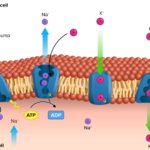 To do this, the pump uses energy from ATP to actively move three sodium ions out of the cell and two potassium ions into the cell. This creates a higher concentration of sodium ions outside the cell and a higher concentration of potassium ions inside the cell.
This difference in concentration helps to establish a voltage difference across the cell membrane, which is important for many cellular functions such as nerve transmission and muscle contraction. The Na+/K+ pump is essential for the proper functioning of cells, and any disruption in its activity can lead to various health problems.